

CONTRIBUTORS

Andrew Ness
Portfolio Manager, Franklin Templeton Emerging Markets Equity
United Kingdom
A performance story with deeper roots
Over the past year, emerging market equities have delivered strong returns, with the MSCI Emerging Markets Index posting gains of close to 30% over the period.1 That improvement has naturally drawn attention, particularly from investors who had grown cautious after a long stretch of uneven performance. It would be easy to dismiss this as a cyclical rebound or a short-term rotation. I think that would miss the bigger picture.
Equity markets (EM) are ultimately driven by earnings, and one of the more consistent features of emerging markets over time has been their ability to generate earnings growth above that of developed economies. Over the past 15 years, earnings growth has been the single largest contributor to emerging market equity returns, outweighing both valuation changes and currency effects.2
What has changed is the quality and durability of those earnings. The drivers today are less dependent on commodity cycles or external demand alone and increasingly anchored in domestic consumption, technology adoption, healthcare provision and financial inclusion.
We see this reflected in how EM markets have responded to recent global shocks. Inflation spikes, aggressive interest rate cycles and geopolitical stress have tested all asset classes. Yet many emerging economies entered this period with stronger balance sheets, more credible monetary frameworks and higher levels of foreign exchange reserves than in previous decades.3 The result has been greater resilience and, in several cases, faster recoveries.
For long-term allocators, that distinction matters. It suggests that recent performance isn’t an outlier but part of a broader structural story—one in which earnings growth, rather than multiple expansion alone, continues to do the heavy lifting.
A changing opportunity set
Perhaps the most underappreciated shift in emerging markets has been the transformation of their economic and market composition. Thirty years ago, EM exposure largely meant banks, energy companies and basic materials producers. Those sectors still matter, but they no longer define the opportunity set.
Emerging markets: Then vs Now
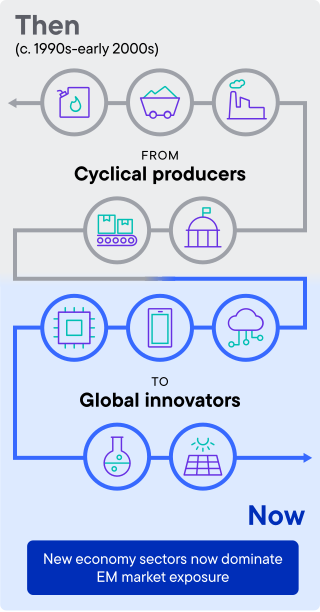
Today, emerging markets are home to many of the companies building the infrastructure of the modern global economy. Semiconductors manufactured in Taiwan and South Korea sit at the heart of digitalisation. Software engineers in India help global firms modernise their operations. Fintech platforms across Latin America and Southeast Asia are bringing millions of people into the formal financial system for the first time. Healthcare providers are scaling access and quality in rapidly ageing populations, while renewable energy developers are deploying capital at a pace that would have been unthinkable a decade ago.
When we look at market indices, this evolution is clear. “New economy” sectors—technology, communication services, healthcare and consumer-oriented businesses—now account for more than half of emerging market equity market capitalisation, while commodities represent less than 15%.4
That shift has materially altered the sources of earnings growth and the way EM equities behave across cycles. And it isn’t just a statistical shift either—it changes the nature of risk and return. Businesses built around intellectual property, platforms and networks have different margin profiles, capital intensity and growth trajectories than traditional cyclicals. Historically, they’ve benefitted disproportionately from scale, urbanisation and rising incomes—trends that remain firmly in place across much of the emerging world.
Innovation closer to home
One of the privileges of working in emerging markets is spending time with local teams who understand these changes from the inside. Over the past year, I have travelled to countries as different as Brazil and India. The contrasts are striking, but so are the common threads.
Brazil is a young, vibrant economy with a highly educated population and deep pools of entrepreneurial talent. India, for all its infrastructure challenges, continues to produce world-class engineers and technology businesses at remarkable speed. Today, emerging markets account for more than half of global patent grants, a share that has risen steadily over the past decade.5 That shift is being led in large part by North Asian companies in China and Korea, particularly in areas such as semiconductors, batteries and advanced manufacturing.
Innovation is no longer something imported into emerging markets—it’s increasingly home-grown.”
That matters for investors because it reshapes where future value is created. It also challenges the perception that emerging markets simply follow developed-world business models with a time lag. In many cases, companies are leapfrogging established approaches altogether.
Endnotes:
- Source: MSCI Emerging Market Index as of 31 December 2025.
- Source: MSCI, Bloomberg. Monthly rolling periods from January 2010 to December 2025. Important data provider notices and terms available at www.franklintempletondatasources.com. Earnings Growth = Multi currency EPS Growth rate. Valuations = Price Earnings Ratio Changes. Currency = Calculated as % difference between MSCI Emerging Markets Index (USD) and MSCI Emerging Markets Index (Local Currency). As most EM securities are listed on local stock exchanges and denominated in local currency, the currency effect captures the currency impact, which is essentially the return differential between the USD return and the local currency return of the securities in aggregate. Past performance is not an indicator or a guarantee of future performance.
- Source: IMF, World Bank; Franklin Templeton Capital Markets Insights Group. EM reserve accumulation and local-currency debt issuance have increased materially since the early 2000s.
- Source: MSCI Emerging Market Index as of 30 June 2025.
- Source: World Intellectual Property Organization. WIPO Statistics Database, September 2025.