
Skip to content

Emerging markets valuation in context

Valuations are often cited as a reason for caution. It is true that emerging market equities have, at times, traded toward the upper end of their long-term price-to-earnings range. Periods of volatility can quickly shift that picture, and recent market weakness in some regions is a reminder that valuations do not move in a straight line. Viewed in isolation, headline multiples can appear uncomfortable—but as always, context matters.

Emerging market equities are often assessed against their own valuation history, which can make current multiples appear elevated. Viewed more broadly, however, emerging markets continue to trade at a discount to developed markets on several measures, even as the quality of the asset class has improved.1 Profitability has strengthened, balance sheets are more resilient, and earnings are increasingly driven by sectors with higher returns on capital and more durable growth profiles. Against that backdrop, today’s valuations look less like a warning sign and more like a reflection of a market that has matured.

Currency dynamics also deserve attention. Many emerging market currencies have benefited from improved external balances and reserve positions. While currency movements are never a one-way street, they no longer represent the persistent structural headwind they once did.

Valuation, in other words, needs to be assessed alongside quality and earnings durability. On that basis, current levels look less like a warning sign and more like a reflection of a maturing asset class.

Risk, redefined rather than removed

None of this is to suggest that emerging markets are risk-free. Episodes of geopolitical tension, currency volatility and commodity shocks remain part of the landscape. Political change, policy missteps and periods of volatility are part of the landscape. These episodes can feel acute when they occur, particularly when global energy prices, currencies or capital flows move abruptly. But they rarely affect all emerging markets in the same way. The difference today is that those risks are more differentiated and, in many cases, better understood.

Emerging markets are not a single macro trade. They are a collection of distinct economies at different stages of development, with varying policy frameworks and reform trajectories. That diversity can be challenging, but it also creates opportunity. Return dispersion in emerging markets is driven far more by individual companies than by countries or sectors, reinforcing the importance of understanding businesses at a granular level.2 It’s an asset class that rewards patience, selectivity and an appreciation of local nuance.

Looking ahead

When I think about the next decade, I am struck less by any single forecast and more by the direction of travel. Short-term cycles will continue to test conviction, but structural forces tend to play out over years, not quarters. United Nations population projections show that the growth of the global working-age population is increasingly concentrated outside advanced economies, as many developed markets face ageing or stagnant labour forces. At the same time, incomes are rising, consumption patterns are evolving, and technology is accelerating change across almost every sector.3

Where global growth is coming from
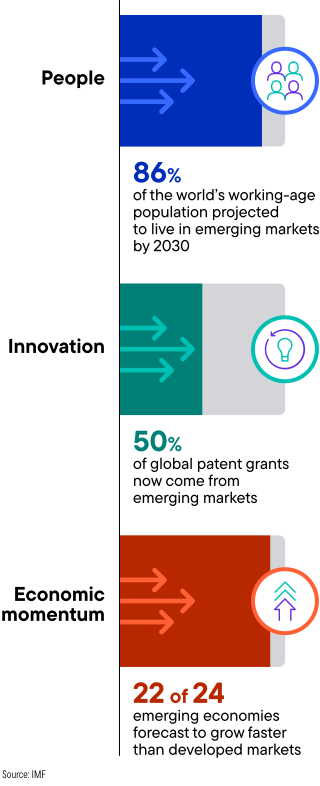
Behind those trends are people: families seeking better healthcare and education, entrepreneurs building businesses to meet local needs, and policymakers trying—sometimes imperfectly—to create more resilient economies. Those human considerations are easy to overlook in macro discussions, but they sit at the heart of long-term economic progress.

In my opinion, the implication is clear. Emerging market equities are no longer just a tactical allocation or a satellite exposure. They represent a structurally important part of the global opportunity set—one that looks increasingly relevant for portfolios built to withstand change and capture growth over time.

The case for emerging markets today isn’t about chasing momentum or ignoring risk. It is about recognising how the asset class has evolved, understanding where future earnings are likely to be generated, and aligning capital with economies that are shaping the next phase of global growth.

At this stage of the cycle, emerging markets deserve to be viewed not as peripheral, but as integral—less a frontier to be approached cautiously, and more a set of economies that are steadily, and convincingly, coming into their own.


IMPORTANT LEGAL INFORMATION

This material is intended to be of general interest only and should not be construed as individual investment advice or a recommendation or solicitation to buy, sell or hold any security or to adopt any investment strategy. It does not constitute legal or tax advice.

The views expressed are those of the investment manager and the comments, opinions and analyses are rendered as at publication date and may change without notice. The information provided in this material is not intended as a complete analysis of every material fact regarding any country, region or market.

Data from third party sources may have been used in the preparation of this material and Franklin Templeton Investments (“FTI”) has not independently verified, validated or audited such data. FTI accepts no liability whatsoever for any loss arising from use of this information and reliance upon the comments opinions and analyses in the material is at the sole discretion of the user.

Products, services and information may not be available in all jurisdictions and are offered outside the U.S. by other FTI affiliates and/or their distributors as local laws and regulation permits. Please consult your own professional adviser or Franklin Templeton institutional contact for further information on availability of products and services in your jurisdiction.

Investments entail risks, the value of investments can go down as well as up and investors should be aware they might not get back the full value invested.

Issued in Luxembourg by Franklin Templeton International Services S.à r.l. Investors can also obtain these documents free of charge from any of the following local authorised FTI representatives: Switzerland: Issued by Franklin Templeton Switzerland Ltd, Talstrasse 41, CH-8001 Zurich.

Australia: Issued by Franklin Templeton Australia Limited (ABN 76 004 835 849, AFSL 240827), Level 47 120 Collins Street, Melbourne, Victoria, 3000. Austria/Germany: Issued by Franklin Templeton Investment Services GmbH, Mainzer Landstraße 16, D-60325 Frankfurt am Main, Germany. Authorised in Germany by IHK Frankfurt M., Reg. no. D-F-125-TMX1-08. Tel. 08 00/0 73 80 01 (Germany), 08 00/29 59 11 (Austria), Fax: +49(0)69/2 72 23-120, [email protected]Canada: Issued by Franklin Templeton Investments Corp., 5000 Yonge Street, Suite 900 Toronto, ON, M2N 0A7, Fax: (416) 364-1163, (800) 387-0830, www.franklintempleton.ca. Netherlands: Issued by Franklin Templeton International Services Sàrl, Dutch branch, NoMA House, Gustav Mahlerlaan 1212, 1081 LA, Amsterdam. United Arab Emirates: Issued by Franklin Templeton Investments (ME) Limited, authorized and regulated by the Dubai Financial Services Authority. Dubai office: Franklin Templeton Investments, The Gate, East Wing, Level 2, Dubai International Financial Centre, P.O. Box 506613, Dubai, U.A.E., Tel.: +9714-4284100 Fax:+9714-4284140. France: Issued by Franklin Templeton France S.A., 20 rue de la Paix, 75002 Paris France. Hong Kong: Issued by Franklin Templeton Investments (Asia) Limited, 17/F, Chater House, 8 Connaught Road Central, Hong Kong. Italy: Issued by Franklin Templeton International Services S.à.r.l. – Italian Branch, Corso Italia, 1 – Milan, 20122, Italy. Japan: Issued by Franklin Templeton Investments Japan Limited. Korea: Issued by Franklin Templeton Investment Trust Management Co., Ltd., 3rd fl., CCMM Building, 12 Youido-Dong, Youngdungpo-Gu, Seoul, Korea 150-968. Luxembourg/Benelux: Issued by Franklin Templeton International Services S.à r.l. – Supervised by the Commission de Surveillance du Secteur Financier - 8A, rue Albert Borschette, L-1246 Luxembourg - Tel: +352-46 66 67-1- Fax: +352-46 66 76. Malaysia: Issued by Franklin Templeton Asset Management (Malaysia) Sdn. Bhd. & Franklin Templeton GSC Asset Management Sdn. Bhd. Poland: Issued by Templeton Asset Management (Poland) TFI S.A.; Rondo ONZ 1; 00-124 Warsaw. Romania: Issued by Bucharest branch of Franklin Templeton Investment Management Limited (“FTIML”) registered with the Romania Financial Supervisory Authority under no. PJM01SFIM/400005/14.09.2009,, and authorized and regulated in the UK by the Financial Conduct Authority. Singapore: Issued by Templeton Asset Management Ltd. Registration No. (UEN) 199205211E. 7 Temasek Boulevard, #38-03 Suntec Tower One, 038987, Singapore. Spain: FTIS Branch Madrid, Professional of the Financial Sector under the Supervision of CNMV, José Ortega y Gasset 29, Madrid, Spain. Tel +34 91 426 3600, Fax +34 91 577 1857. South Africa: Issued by Franklin Templeton Investments SA (PTY) Ltd which is an authorised Financial Services Provider. Tel: +27 (21) 831 7400 ,Fax: +27 (21) 831 7422. Switzerland: Issued by Franklin Templeton Switzerland Ltd, Talstrasse 41, CH-8001 Zurich. UK: Issued by Franklin Templeton Investment Management Limited (FTIML), registered office: Cannon Place, 78 Cannon Street, London EC4N 6HL Tel +44 (0)20 7073 8500. Authorized and regulated in the United Kingdom by the Financial Conduct Authority. Nordic regions: Issued by Franklin Templeton International Services S.à r.l. , Contact details: Franklin Templeton International Services S.à.r.l., Swedish branch c/o Cecil Coworking, Norrlandsgatan 10, 111 43 Stockholm, Sweden. Tel +46 (0)8 545 012 30, [email protected], authorised in the Luxembourg by the Commission de Surveillance du Secteur Financier to conduct certain financial activities in Denmark, in Sweden, in Norway, in Iceland and in Finland. Offshore Americas: In the U.S., this publication is made available only to financial intermediaries by Templeton/Franklin Investment Services, 100 Fountain Parkway, St. Petersburg, Florida 33716. Tel: (800) 239-3894 (USA Toll-Free), (877) 389-0076 (Canada Toll-Free), and Fax: (727) 299-8736. Investments are not FDIC insured; may lose value; and are not bank guaranteed. Distribution outside the U.S. may be made by Templeton Global Advisors Limited or other sub-distributors, intermediaries, dealers or professional investors that have been engaged by Templeton Global Advisors Limited to distribute shares of Franklin Templeton funds in certain jurisdictions. This is not an offer to sell or a solicitation of an offer to purchase securities in any jurisdiction where it would be illegal to do so.
Please visit www.franklinresources.com to be directed to your local Franklin Templeton website.

CFA® and Chartered Financial Analyst® are trademarks owned by CFA Institute.