

CONTRIBUTORS

Francis Gannon
Co-Chief Investment Officer, Managing Director, Royce Investment Partners
In the eventful quarter that closed the books on 2025, the small-cap Russell 2000 and Russell Microcap Indexes were each in positive territory, while the micro-cap index led all the major domestic indexes, solidifying the market leadership that began off the April low.
The market backdrop was decidedly more volatile in 4Q25. On one side, there was lingering inflation, increased unemployment, periodic unwinding of the artificial intelligence (AI) trade, talk of market bubbles, and declines in consumer confidence; on the other, there was a growing US economy, a still resilient stock market, and lower interest rates—all of which more than counterbalanced the uncertainty and bad news.
For 4Q25, the Russell 2000 increased 2.2% while the Russell Microcap advanced 6.3%, the twelfth largest quarterly spread between the small- and micro-cap indexes since the inception of the Russell Microcap in 2000. By comparison, the large-cap Russell 1000 Index was up 2.4%, while the mega-cap Russell Top 50 Index gained 3.0%, showing signs—at long last we would argue—of relinquishing leadership.
Micro-Caps Finished Strong
4Q25 Russell Index Returns
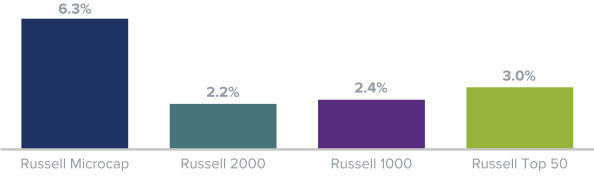
Source: Russell Investments. Past performance is no guarantee of future results. Please note that an investor cannot invest directly in an index. Unmanaged index returns do not reflect any fees, expenses or sales charges.
For the calendar year, the Russell Microcap led the way, while small-caps trailed large- and mega-cap stocks, thanks in large part to a dismal 1Q25 for the Russell 2000. For 2025 as a whole, the Russell Microcap was up 23.0%, the Russell 2000 gained 12.8%, the Russell 1000 rose 17.4%, and the Russell Top 50 increased 19.9%. The calendar-year spread between the small- and micro-cap indexes was the third widest since the micro-cap index’s 2000 inception.
US small- and micro-caps show their strength off the market low
We have often talked about the importance of market cycle performance. We have always seen it as the true test of an investment strategy’s mettle. So, while the calendar year’s relative returns were somewhat disappointing for the Russell 2000, we were pleased with both the absolute and relative results for small cap from the market low on 4/8/25 through the end of the year—and even happier with the extraordinary results for micro-caps.
From 4/8/25 through 12/31/25, the Russell Microcap advanced an impressive 63.5%, and the Russell 2000 rose 42.4%, while the Russell 1000 was up 38.5%, and the Russell Top 50 gained 46.1%.
Micro-Cap’s Very Impressive Return Off the April Market Low
Russell Index Returns, 4/8/25-12/31/25
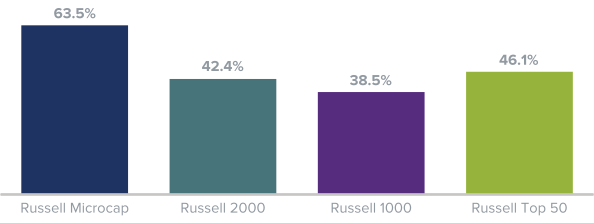
Source: Russell Investments. Past performance is no guarantee of future results. Please note that an investor cannot invest directly in an index. Unmanaged index returns do not reflect any fees, expenses or sales charges.
Foreign affairs
Results for non-US stocks were similar to their stateside peers in 4Q25, though they favored large-caps over small. The MSCI ACWI ex-USA Small Cap Index rose 3.0% in 4Q25 while its large-cap counterpart, the MSCI ACWI ex-USA Large Cap Index, was up 5.5%.
Calendar year performance was impressive for both asset classes. Non-US large-caps outpaced non-US small-caps, but the spread was not wide. The MSCI ACWI ex-USA Small Cap advanced 29.3% in 2025 while the MSCI ACWI ex-USA Large Cap gained 32.5%. Some of the reasons behind large-cap’s advantage included higher interest rates outside the United States, widespread macroeconomic uncertainty, the view that larger international companies offer more earnings stability, and an emerging markets rally that disproportionately benefited large-cap stocks in 2025.
The small-cap style story
For the second consecutive quarter, the Russell 2000 Value Index beat the Russell 2000 Growth Index, up 3.3% versus 1.2% in 4Q25, a somewhat counterintuitive stretch of outperformance in that small-cap value often trails in the kind of dynamic upswing small-caps have been enjoying since early April.
And while small-cap growth had the advantage in 2025, the spread was quite narrow. For the calendar year, the Russell 2000 Growth advanced 13.0% versus 12.6% for the Russell 2000 Value. As is typically the case, annualized results over longer periods were mixed in terms of style leadership. Small-cap growth was ahead for the 3-year (+15.6% versus +11.7%) and 10-year (9.6% vs. 9.3%) periods. Small-cap value, however, had a decisive advantage for the 5-year span, rising 8.9% compared to 3.2% for the small-cap growth index.
Unsurprisingly, small-cap growth had the advantage off the April low, though once again the performance spread was thin. From 4/8/25-12/31/25, the Russell 2000 Growth was up 45.0% versus a 39.7% advance for the Russell 2000 Value.
The small-cap sector story: a healthy quarter
Six of the 11 sectors in the Russell 2000 were in the black in 4Q25. Health care contributed the most by a wide margin, boosted by biotechnology and pharmaceuticals. Financials and materials were the other top contributors while the top detractors were information technology, consumer discretionary, and industrials.
For 2025, industrials, health care, and financials led nine sectors that finished the year in the black while the two detractors were consumer staples and energy. As they were in the fourth quarter, biotech stocks were especially strong in 2025, thanks in part to the US Food and Drug Administration (FDA) fast-tracking a number of drugs, treatments, and breakthrough therapy designations. Other factors driving performance for the industry were attractively low valuations for many companies at the beginning of 2025, as well as advances in gene editing, RNA therapies, and AI-enhanced drug discovery. The dynamic performance of biotechs also helps to explain the strength of small-cap growth in 2025.
A confident forecast for small-cap and active management
As we think about small-cap’s prospects in the new year, we see several factors that can drive both strong returns and overall market leadership. For the purposes of this discussion, we include micro-caps under the broad and diverse small-cap universe. First, one of the more interesting elements in the One Big Beautiful Bill Act of 2025 is the fact that companies can have 100% depreciation on research and capital expenditure (capex)—which suggests that we could see a robust capex cycle in 2026. Such cycles have typically meant good things for small-cap stocks, though we believe the market has not yet caught on to this. We expect that to change as the year progresses.
We also see a shift in the AI trade, which has mostly benefited the very largest companies thus far. We anticipate two developments that can benefit smaller companies. First, we think investors will begin to recognize the large number of small-cap businesses that are supplying the AI revolution, including, but not limited to, the semiconductor components that enable various AI applications, energy providers crucial to the functioning of data centers, and the construction companies that are building them. Second is a shift emphasis from the mega-cap companies that are providing AI to the many companies that we think are likely to begin to benefit from AI in 2026.
Active management will likely be critical in sourcing those smaller companies that stand to do best in what is shaping up to be a vigorous, though at times highly volatile, market this year.
Do earnings + valuations = sustained small-cap leadership?
We think the most compelling case for small-cap leadership in 2026 comes from a relatively rare and promising confluence of factors: Relatively low valuations for small-cap versus large-cap and the forecast for higher earnings for small-cap companies. We think it’s important to mention that small-caps’ terrific year notwithstanding, valuations for the Russell 2000 at the end of 2025 were still quite close to their lowest levels versus the Russell 1000 in 25 years. This comparison is based on using our preferred index valuation metric of EV/EBIT or enterprise value over earnings before interest and taxes.
Relative Valuations for Small-Caps vs. Large-Caps Remain Near Their Lowest in 25 Years
Russell 2000 vs. Russell 1000 Median Last-Twelve-Months EV/EBIT (ex. Negative EBIT Companies), 12/31/00 through 12/31/25
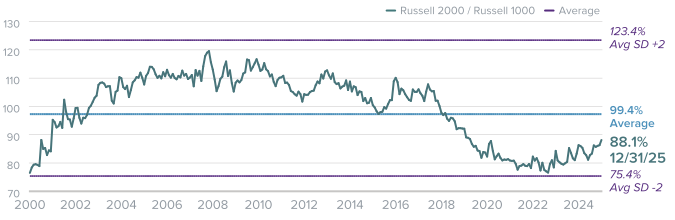
Source: FactSet. Past performance is no guarantee of future results. SD = standard deviation which is a measure of the spread of data around the mean value. It is used in comparisons of consistency between different data sets.
But the argument in favor of small-cap leadership is greatly enhanced by the promising earnings picture for 2026. We have always subscribed to the adage that psychology runs the market in the short term, but earnings run it in the long term. Earnings for across asset classes were generally positive in 3Q25, with many companies handily beating estimates. Smaller companies, however, generally fared better in terms of earnings growth. Even more encouraging, the research we have seen forecasts accelerated earnings growth for small-cap stocks in 2026. Three Fed rate cuts in the second half of 2025 have provided a boost, and additional catalysts, including possible tariff relief, reshoring, and ongoing infrastructure improvements, should also help vault small-caps into a sustained leadership role. This includes the aforementioned possibility of a healthy capex cycle and the benefits accruing to those small-cap companies that are providing AI’s “picks & shovels.”
Small-Cap’s Estimated Earnings Growth is Expected to Be Higher Than Large-Cap’s in 2026
One-Year EPS Growth

Source: FactSet. Past performance is no guarantee of future results. Earnings per share (EPS) is calculated as a company’s profit divided by the outstanding shares of its common stock. The EPS Growth Estimates are the pre-calculated mean two-year EPS growth rate estimates by brokerage analysts. Estimates are the average of those provided by analysts working for brokerage firms who provide research coverage on each individual security as reported by FactSet. All non-equity securities, investment companies, and companies without brokerage analyst coverage are excluded.
We enter 2026 with more than the usual amount of uncertainty for both the US economy and on the geopolitical front. Yet our investment teams remain confident that small-cap can build on its nascent market leadership. Finally, we want to remind investors that the opportunity still exists to build one’s small-cap allocation at attractive valuations. We continue to see the current period as an opportune time to invest in select small-caps for the long run.
Definitions
The Russell 1000 Index is an unmanaged, capitalization-weighted index of domestic large-cap stocks. It measures the performance of the 1,000 largest publicly traded US companies in the Russell 3000 Index.
The Russell 2000 Index is an index of domestic small-cap stocks that measures the performance of the 2,000 smallest publicly traded US companies in the Russell 3000 Index.
The Russell Top 50 Index is a market-capitalization-weighted index of the 50 largest stocks in the broad-based Russell 3000 universe of US-based equities.
The Russell Microcap Index measures the performance of the microcap segment of the US equity market. Microcap stocks make up less than 3% of the US equity market (by market cap) and consist of the smallest 1,000 securities in the small-cap Russell 2000® Index, plus the next smallest eligible securities by market cap.
The Russell 2000 Value and Growth indexes consist of the respective value and growth stocks within the Russell 2000 as determined by Russell Investments.
The MSCI ACWI ex USA Small Cap Index is an unmanaged, capitalization weighted index of global small-cap stocks, excluding the United States.
The MSCI ACWI ex USA Large Cap Index is an unmanaged, capitalization weighted index of global large-cap stocks, excluding the United States.
Enterprise value (EV) refers to the entire value of a company after taking into account both holders of debt and equity.
The EV/EBIT multiple is the ratio between enterprise value (EV) and earnings before interest and taxes (EBIT).
“AI pick and shovels” refers to the companies and sectors that provide the foundational tools, infrastructure, and services necessary for the development and operation of AI, rather than the consumer-facing AI applications themselves.
Capital expenditure (capex) refers to investment spending in long-term assets (fixed assets). These expenditures include new buildings, machinery, and other equipment needed for an organization's day-to-day operations. Most companies use capex financing to fund their long-term investments.
The One Big Beautiful Bill Act of 2025 is a US federal statute passed by the 119th United States Congress containing tax and spending policies that form the core of President Donald Trump's second-term agenda. The bill was signed into law by President Trump on July 4, 2025.
WHAT ARE THE RISKS?
All investments involve risks, including possible loss of principal. Past performance is no guarantee of future results. Please note that an investor cannot invest directly in an index. Unmanaged index returns do not reflect any fees, expenses or sales charges.
Active management does not ensure gains or protect against market declines.
Equity securities are subject to price fluctuation and possible loss of principal.
Commodities and currencies contain heightened risk that include market, political, regulatory, and natural conditions and may not be suitable for all investors.
Small- and mid-cap stocks involve greater risks and volatility than large-cap stocks.
US Treasuries are direct debt obligations issued and backed by the “full faith and credit” of the US government. The US government guarantees the principal and interest payments on US Treasuries when the securities are held to maturity. Unlike US Treasuries, debt securities issued by the federal agencies and instrumentalities and related investments may or may not be backed by the full faith and credit of the US government. Even when the US government guarantees principal and interest payments on securities, this guarantee does not apply to losses resulting from declines in the market value of these securities.
Any companies and/or case studies referenced herein are used solely for illustrative purposes; any investment may or may not be currently held by any portfolio advised by Franklin Templeton. The information provided is not a recommendation or individual investment advice for any particular security, strategy, or investment product and is not an indication of the trading intent of any Franklin Templeton managed portfolio. Past performance does not guarantee future results.
Any data and figures quoted in this article sourced from Russell Investments, FactSet, Bloomberg and Reuters.
Important data provider notices and terms available at www.franklintempletondatasources.com. All data is subject to change.
WF: 8156158