

CONTRIBUTORS

Chuck Royce
Chairman, Portfolio Manager

Francis Gannon
Co-Chief Investment Officer, Managing Director
Were you surprised by the market's increased volatility through the last six weeks of 2024?
Francis Gannon: Somewhat, yes, if only because December has so often been a positive month. Think of how often we hear the phrase “Santa Claus rally” near the end of most years. Stocks had been on quite a tear going into the last full week of November—and really for the last two years. In fact, large-caps hadn’t posted two consecutive years of 20%-plus performance since the late ‘90s—a period of large-cap dominance that presaged a long period of small-cap leadership. From 1999 through 2010, the Russell 2000 Index beat the large-cap Russell 1000 Index in eight of 12 calendar years.
How did performance shake out for the year as a whole?
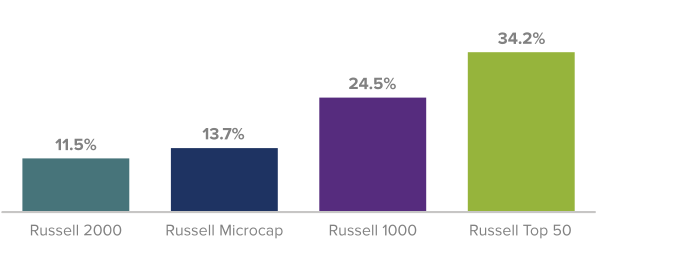
Chuck Royce: Small-caps trailed large-caps, with the Russell 2000 advancing 11.5% versus a gain of 24.5% for the Russell 1000. Curiously, micro-caps fared better than small-caps—the Russell Microcap increased 13.7% in 2024—and mega-caps fared better than large-caps. The Russell Top 50 Index rose 34.2%. Yet the most telling statistic from 2024 might be that small-cap trailed large-cap for the eighth consecutive year—which is a record that goes back more than 40 years to the inception of the Russell 2000 and Russell 1000 on 12/31/78. In fact, the Russell 1000 had never beaten its small-cap sibling for more than four straight years prior to 2016—and it enjoyed four consecutive years of outperformance only twice, from 1984 through 1987 and from 1995 through 1998. So we understand that small-cap investors are frustrated, even after two years of positive double-digit returns. On a relative basis, it’s been a challenging period for all of us who specialize in the asset class.
A Big Year for Large-Cap
Russell Index Returns, 12/31/23-12/31/24
Source: Russell Investments. Past performance is no guarantee of future results.
Do you anticipate more volatility in 2025?
Francis Gannon: We do. It’s interesting to us that these periods of lower-than-average volatility often lull investors into a sense that markets will remain placid or predictable going forward. Yet history shows very clearly that volatility always spikes sooner or later, and almost always without warning—which of course exacerbates the volatility. Over most of the last two years, volatility has been lower, as measured by the VIX. With brief exceptions, such as a short-lived spike in early August 2024, large-cap stocks enjoyed an uncommonly quiet year in 2024, just as they did in 2023.
Chuck Royce: Of course, small-caps were relatively more volatile than their large-cap counterparts, specifically in 2023. Within small-cap, we gauge volatility by looking at the percentage of trading days with up or down moves of at least 1%. Over the last 25 years, the Russell 2000 has averaged 42% of trading days having such moves. In 2023, 46% (or 116 out of 250 days) had moves of at least 1%. In 2024, it was 41%, or 103 out of 252 days—which made last year a slightly less volatile period than average. Whether for small- or large-cap, lower levels of volatility simply cannot persist indefinitely—which we see as a positive. We’ve never seen increased volatility through the conventional lens of fear but with the longer-range vista of opportunity. As risk-averse and price sensitive long-term investors, we welcome higher volatility and always work to use it to our long-term advantage.
Does earnings growth for US small-cap still look relatively better than the prospects for US large cap's earnings in 2025?
Francis Gannon: Market-wide, earnings are expected to be pretty healthy, with the current consensus indicating 15% earnings per share (“EPS”) growth for the Russell 1000, along with solid to strong results anticipated for 4Q24, which will be reported in the coming weeks. Consensus EPS estimates for the Russell 2000, however, are considerably higher than they are for large-caps in 2025, coming in at an impressive 44%.
There’s some important context here: small-caps as a whole finished 2024 having endured a two-year earnings recession, so a rebound makes a certain amount of sense. It’s also important to keep in mind that more than 40% of the companies in the Russell 2000 currently have no earnings. Our own portfolios typically hold companies that have established histories of earnings or those where our respective investment teams have identified a catalyst for earnings to resume or begin.
What is your outlook for active US small cap management going forward?
Francis Gannon: We realize that people may be a little tired of hearing it, but we feel very good about the prospects for small-cap leadership in 2025—and our optimism is even higher for active small-cap leadership. The very promising earnings prospects are a major factor in our thinking, of course, but our conviction becomes even stronger when combined with small-cap’s far more attractive valuations compared to large-cap. Using our preferred index valuation metric of enterprise value over earnings before interest and taxes—or EV/EBIT—we see that the Russell 2000 finished 2024 still near its lowest levels relative to the Russell 1000 in 25 years. To us, this combination signals an ongoing opportunity for active small-cap managers to capture robust earnings growth at attractive—highly attractive in many cases—prices. Recent underwhelming relative performance has not made us any less confident in the long-term case for small-cap leadership.
Definitions
The Russell 1000 Index is an unmanaged, capitalization-weighted index of domestic large-cap stocks. It measures the performance of the 1,000 largest publicly traded US companies in the Russell 3000 Index.
The Russell 2000 Index is an index of domestic small-cap stocks that measures the performance of the 2,000 smallest publicly traded US companies in the Russell 3000 Index.
The Russell Microcap Index measures the performance of the microcap segment of the US equity market.
The Russell Top 50 Mega Cap Index is a market-capitalization-weighted index of the 50 largest stocks in the broad-based Russell 3000 universe of US-based equities.
The Standard & Poor’s® 500 Index (S&P 500®) is a market capitalization-weighted index of 500 stocks designed to measure total US equity market performance.
VIX is the ticker symbol and the popular name for the Chicago Board Options Exchange's CBOE Volatility Index, a popular measure of the stock market's expectation of volatility based on S&P 500 index options.
Enterprise value (EV) refers to the entire value of a company after taking into account both holders of debt and equity.
The EV/EBIT multiple is the ratio between enterprise value (EV) and earnings before interest and taxes (EBIT).
WHAT ARE THE RISKS?
All investments involve risks, including possible loss of principal. Past performance is no guarantee of future results. Please note that an investor cannot invest directly in an index. Unmanaged index returns do not reflect any fees, expenses or sales charges.
Equity securities are subject to price fluctuation and possible loss of principal.
Commodities and currencies contain heightened risk that include market, political, regulatory, and natural conditions and may not be suitable for all investors.
Small- and mid-cap stocks involve greater risks and volatility than large-cap stocks.
US Treasuries are direct debt obligations issued and backed by the “full faith and credit” of the US government. The US government guarantees the principal and interest payments on US Treasuries when the securities are held to maturity. Unlike US Treasuries, debt securities issued by the federal agencies and instrumentalities and related investments may or may not be backed by the full faith and credit of the US government. Even when the US government guarantees principal and interest payments on securities, this guarantee does not apply to losses resulting from declines in the market value of these securities.
Any companies and/or case studies referenced herein are used solely for illustrative purposes; any investment may or may not be currently held by any portfolio advised by Franklin Templeton. The information provided is not a recommendation or individual investment advice for any particular security, strategy, or investment product and is not an indication of the trading intent of any Franklin Templeton managed portfolio. Past performance does not guarantee future results.
Any data and figures quoted in this article sourced from Russell Investments, FactSet, Bloomberg and Reuters.
Important data provider notices and terms available at www.franklintempletondatasources.com. All data is subject to change.